


08-09-2010, 06:59 PM

A digital single-lens reflex camera (digital SLR or DSLR) is a digital camera that uses a mechanical mirror system and pentaprism to direct light from the lens to an optical viewfinder on the back of the camera.
The basic operation of a DSLR is as follows: for viewing purposes, the mirror reflects the light coming through the attached lens upwards at a 90 degree angle. It is then reflected three times by the roof pentaprism, rectifying it for the photographer's eye. (Note that the drawing incorrectly shows a non-roof pentaprism.) During exposure, the mirror assembly swings upward, the aperture narrows (if stopped down, or set smaller than wide open), and a shutter opens, allowing the lens to project light onto the image sensor. A second shutter then covers the sensor, ending the exposure, and the mirror lowers while the shutter resets. The period that the mirror is flipped up is referred to as "viewfinder blackout". A fast-acting mirror and shutter is preferred so as to not delay an action photo. All of this happens automatically over a period of milliseconds, with cameras designed to do this 3–10 times a second.
DSLRs are often preferred by professional still photographers because they allow an accurate preview of framing close to the moment of exposure, and because DSLRs allow the user to choose from a variety of interchangeable lenses. Most DSLRs also have a function that allows accurate preview of depth of field.
Many professionals also prefer DSLRs for their larger sensors compared to most compact digitals. DSLRs have sensors which are generally closer in size to the traditional film formats that many current professionals started out using. These large sensors allow for similar depths of field and picture angle to film formats, as well as their comparatively low signal to noise ratio.The term DSLR generally refers to cameras that resemble 35 mm format cameras, although some medium format cameras are technically DSLRs.
Comparison with digital point-and-shoot camera
The reflex design scheme is a major difference between a DSLR and an ordinary digital point-and-shoot camera, which typically exposes the sensor constantly to the light projected by the lens, allowing the camera's screen to be used as an electronic viewfinder.
In contrast, the mirror arrangement in a DSLR usually precludes the ability to view the scene on the liquid crystal display (LCD) before the photograph is taken. However, many newer DSLR models feature live preview, allowing the LCD to be used as a viewfinder in the same way as a normal digicam, although with certain limitations and with the optical viewfinder disabled.
DSLR design principles
A camera based on the single-lens reflex (SLR) principle uses a mirror to show in a viewfinder the image that will be captured. The cross-section (side-view) of the optical components of an SLR shows how the light passes through the lens assembly (1), is reflected into the pentaprism by the reflex mirror (which must be at an exact 45 degree angle) (2) and is projected on the matte focusing screen (5). Via a condensing lens (6) and internal reflections in the roof pentaprism (7) the image is projected through the eyepiece (Cool to the photographer's eye. Focusing is either automatic, activated by pressing half-way on the shutter release or a dedicated AF button, as is mainly the case with an autofocusing film SLR; or manual, where the photographer manually focuses the lens by turning a lens ring on the lens barrel. When an image is photographed, the mirror swings upwards in the direction of the arrow, the focal-plane shutter (3) opens, and the image is projected and captured on the sensor (4), after which actions, the shutter closes, the mirror returns to a critical 45 degree angle, and the diaphragm reopens and the built in drive mechanism re-tensions the shutter for the next exposure. There is often a ring of soft material around the focusing screen, which helps to both cushion the impact of the mirror slapping up and help seal the mirror box from light entering through the eye piece.[1] Some high end cameras incorporate a shutter into the eyepiece to further eliminate light that may enter there during long exposures.
Fast phase-detection autofocus
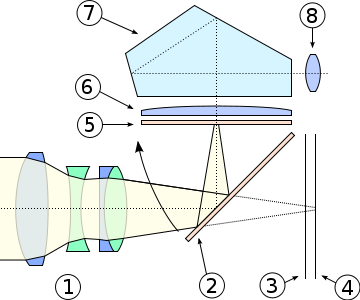
Cross-section view of DSLR system:
1. 4-element lens
2. Reflex mirror
3. Focal-plane shutter
4. Image sensor
5. Matte focusing screen
6. Condenser lens
7. Pentaprism
8. Eyepiece
The diagram shown here is an over-simplification in that it omits the sensors used to activate the drive for the autofocus system. Those sensors reside at the bottom of the mirror box. In such a system, the main mirror is slightly translucent in the center, which allows light to pass through it to a secondary mirror which reflects light to the sensors below.
DSLRs typically use a phase detection autofocus system. This method of focus is very fast, and results in less focus "searching", but requires the incorporation of a special sensor into the optical path, so it is usually only used in SLR designs. Digicams that use the main sensor to create a live preview on the LCD or electronic viewfinder must use contrast-detect autofocus instead, which is slower in some implementations.
[edit] DSLR optical viewfinder vs. digital point-and-shoot camera LCD
Depending on the viewing position of the reflex mirror (down or up), the light from the scene can only reach either the viewfinder or the sensor. Therefore, many older DSLRs do not provide "live preview" (allowing focusing, framing, and depth-of-field preview using the display), a facility that is always available on digicams although today most DSLRs offer live view.
The advantages of an optical viewfinder are that it alleviates eye-strain sometimes caused by electronic view finders (EVF), and that it constantly shows (except during the time for the sensor to be exposed) the exact image that will be exposed because its light is routed directly from the lens itself. Compared to ordinary digital cameras with their LCDs and/or electronic viewfinders the advantage is that there is no time lag in the image; it is always correct as it is being "updated" at the speed of light. This is important for action and/or sports photography, or any other situation where the subject or the camera is moving too quickly. Furthermore, the "resolution" of the viewed image is much better than that provided by an LCD or an electronic viewfinder, which can be important if manual focusing is desired for precise focusing, as would be the case in macro photography and "micro-photography" (with a microscope).
Compared to some low cost cameras that provide an optical viewfinder that uses a small auxiliary lens, the DSLR design has the advantage of being parallax-free; that is, it never provides an off-axis view.
A disadvantage of the DSLR optical viewfinder system is that while it is used it prevents the possibility of using the LCD for viewing and composing the picture before taking it. Some people prefer to compose pictures on the display – for them this has become the de-facto way to use a camera. Electronic viewfinders may also provide a brighter display in low light situations, as the picture can be electronically amplified; conversely, LCDs can be difficult to see in very bright sunlight.
DSLRs with live preview
A fairly recent development in DSLRs is the increased availability of live preview options, which make it possible to use either the optical viewfinder or the LCD when composing the picture (but not both at the same time). This can be an advantage because some people simply prefer to use the display and because in some situations it is not convenient or possible to hold the camera up to one's face to look through the viewfinder. Underwater photography, where the camera is enclosed in a plastic waterproof case, is an example of a situation where composing on the display is preferred. On most DSLRs, a disadvantage when using live preview is that the phase detection autofocus system does not work and the slower contrast system used in non DSLRs must be used.
Olympus introduced the first DSLR with live preview – albeit an atypical design with a fixed lens – the Olympus E-10, in the summer of 2000. Since then other manufacturers have launched DSLR models with live preview.
In late 2008[update], some DSLRs from Canon, Nikon, Olympus, Panasonic, Leica, Pentax, Samsung and Sony all provide continuous live preview as an option. Additionally, the Fujifilm FinePix S5 Pro[2] offers 30 seconds of live preview.
Some live preview systems make use of the primary sensor to provide the image on the LCD (which is the way all non-DSLR digicams work), and some systems use a secondary sensor. Possible advantages of using a secondary sensor for live preview is to avoid additional noise that might result from the primary sensor heating up from continuous use, and allowing faster auto-focus.[3]
A new feature via a separate software package introduced from Breeze Systems in October, 2007, features live view from a distance. The software package is named "DSLR Remote Pro v1.5" and enables support for the Canon EOS 40D and 1D Mark III.[4]
High Definition DSLRs (HDSLRs)
Introduced in 2008, HDSLRs are DSLRs which, in addition to taking still-photographs, offer a movie-mode capable of recording high definition motion-video. This feature parallels the evolution of compact digital cameras, many of which also offer HD-movie mode. The first HDSLR, the Nikon D90, captures video at 720p24 (1280x720 resolution at 24 fps) using an APS-sized sensor. The Canon EOS 5D Mark II captures video at 1080p30 (1920x1080 resolution at 30 fps), as well as 1080p24 (1920x1080 resolution at 24 fps) using a full frame 35mm CMOS sensor. The 720/24p of the Nikon D90 is not a compliant frame rate for High-definition television broadcast, Blu-ray Disc mastering[5] or Digital Cinema Initiatives (DCI). The first HDSLR to shoot a standard HD broadcast, Blu-ray and Digital Cinema format is the Panasonic Lumix GH1 (both 1920x1080/23.976p and 1280x720/59.94p). With the release of the Canon 7D, there are now three HDSLRs that can shoot in these standard/broadcast compliant resolutions and frame rates, with the Canon EOS 5D Mark II adding 24p and industry compliance with the release of firmware version 2.0.3/2.0.4.[2] Less than a year after the introduction of the first HDSLR, "HD-movie mode" was incorporated into entry-level DSLR camera models, the first being the Canon EOS 500D (Rebel T1i) and Nikon D5000. The 500D supports both 720p30 and a limited 1080p mode which captures 20 fps. The D5000's movie-mode is comparable to the D90, with a maximum capture-mode of 720p24. These entry-level cameras also use non-standard resolution and frame rate combinations.
On 20 May 2009, Pentax announced its K-7 HDSLR. It supports non-broadcast/blu-ray/DCI compliant HD capture at 30 fps, in both 720p resolution, and an unusual non-standard resolution mode of 1536×1024 which matches the 3:2 aspect ratio of the image sensor.
References
1. ^ United States Patent: 4104652
2. ^ Simon Joinson (July 2007). "Fujifilm FinePix S5 Pro Review". Digital Photography Review. http://www.dpreview.com/reviews/fujifilms5pro/. Retrieved 2007-12-07.
3. ^ "Interview: Yoshiyuki Nada, Olympus' Technical Product Manager". http://www.quesabesde.com/noticias/olymp...,1_en_2256. Retrieved 2006-01-06.
4. ^ dpreview.com (October 2, 2007). "Live view from a distance with DSLR Remote Pro v1.5". Digital Photography Review. http://www.dpreview.com/news/0710/071002...remote.asp. Retrieved 2007-10-07.
5. ^ "Blue-ray Disc Format White Paper". 2005-03. http://www.blu-raydisc.com/Assets/Downlo...-15269.pdf. Retrieved 2009-10-03.
6. ^ "Sigma Corporation of America". http://www.sigmaphoto.com/. Retrieved 2007-12-07.
7. ^ "Tamron USA". http://www.tamron.com/B. Retrieved 2007-12-09.
8. ^ "Tokina". http://www.tokinalens.com/. Retrieved 2007-12-07.
9. ^ "Vivitar". http://www.vivitar.com/. Retrieved 2007-12-07.
10. ^ "How Nikon bettered Canon with full-frame SLRs". 2007-12-17. http://news.cnet.com/8301-13580_3-9834860-39.html. Retrieved 2009-08-13.
11. ^ "Leica S2 with 56% larger sensor than full frame"
12. ^ Bockaert, Vincent. "Sensor sizes". Digital Photography Review. http://www.dpreview.com/learn/?/key=sensor sizes. Retrieved 2007-12-06.
13. ^ Defined here as the ratio of the diagonal of a full 35 frame to that of the sensor format, that is CF=diag35mm / diagsensor.
14. ^ http://www.cambridgeincolour.com/tutoria...graphy.htm
15. ^ http://www.dpreview.com/news/0609/06091405_canon_g7.asp
16. ^ http://www.cambridgeincolour.com/tutoria...r-size.htm
17. ^ http://www.cambridgeincolour.com/tutoria...-field.htm
18. ^ Fargo, Curt (2006). "Demystifying D-SLR Sensor Cleaning". CleaningDigitalCameras.com. http://www.cleaningdigitalcameras.com/methods.html. Retrieved 2008-03-07.
19. ^ diglloyd: An Hour with the Hasselblad H3D-39
20. ^ diglloyd: An Hour with the Hasselblad 503 CWD
21. ^ [1]
22. ^ Hasselblad H System.
23. ^ Leaf AFi.
24. ^ Fujifilm FinePix IS Pro digital camera specifications: Digital Photography Review
25. ^ a b Nikon SLR-type digital cameras, Pierre Jarleton
26. ^ A brief info on Kodak DCS-Series Digital Still SLR cameras, Photography in Malaysia
27. ^ "IDC on 2007 Sales: Nikon, Sony Gain in dSLRs; Samsung Up, Kodak Holds On in Digicams". [imaging-resource.com]. 2008-04-07. http://www.imaging-resource.com/NEWS/1207604859.html. Retrieved 2008-04-08.
28. ^ "'Big two' continue to dominate Japan". DPreview.com. 2008-01-11. http://www.dpreview.com/news/0801/080111...nsales.asp. Retrieved 2008-04-08.
29. ^ a b The Canon EOS 1000D and EOS 450D are known as the EOS Rebel XS and EOS Rebel XSi, respectively, in North America.
30. ^ "Nikon D3, Full-Frame, previewed". Digital Photography Review. 2007-08-23. http://www.dpreview.com/news/0708/070823....asp#press. Retrieved 2008-04-08.
31. ^ "Olympus 12-60 lens dpreview". Digital Photography Review. http://www.dpreview.com/lensreviews/olym.../page4.asp.
32. ^ "Olympus 9-18 lens dpreview". Digital Photography Review. http://www.dpreview.com/lensreviews/olym.../page4.asp.
33. ^ The Pentax K-m is known as the K2000 in North America.
34. ^ "Demystifying Digital Camera Types". 2007-09-21. http://www.neocamera.com/feature_camera_types.html.
35. ^ "Sensor Sizes". http://www.dpreview.com/learn/?/Glossary...zes_01.htm.
36. ^ "The Advantage of Digital SLR Cameras". http://www.digital-slr-guide.com/advanta...meras.html.
37. ^ "Five reasons to buy a dSLR". 2006-12-15. http://www.cnet.com.au/digitalcameras/ca...693,00.htm.
38. ^ "REVIEW: Understanding Depth Of Field". http://www.luminous-landscape.com/tutori.../dof.shtml.
39. ^ "10 Reasons to Buy a DSLR Camera". 2006-11-05. http://www.thetechlounge.com/article/308/10 Reasons to Buy a DSLR Camera/.
40. ^ a b c "10 Reasons NOT to Buy a DSLR Camera". 2006-11-14. http://www.thetechlounge.com/article/312/10 Reasons NOT to Buy a DSLR Camera/.
41. ^ "REVIEW: Canon EOS 5D Mark II". February 2009. http://www.dpreview.com/reviews/canoneos...page19.asp.
42. ^ "REVIEW: Canon Powershot S3 IS". July 2006. http://www.luminous-landscape.com/review...view.shtml.
43. ^ "Digicams vs. DSLRs". http://www.luminous-landscape.com/essays...slrs.shtml.
44. ^ Sony Cyber-shot DSC-R1 Review: 1. Introduction: Digital Photography Review
The basic operation of a DSLR is as follows: for viewing purposes, the mirror reflects the light coming through the attached lens upwards at a 90 degree angle. It is then reflected three times by the roof pentaprism, rectifying it for the photographer's eye. (Note that the drawing incorrectly shows a non-roof pentaprism.) During exposure, the mirror assembly swings upward, the aperture narrows (if stopped down, or set smaller than wide open), and a shutter opens, allowing the lens to project light onto the image sensor. A second shutter then covers the sensor, ending the exposure, and the mirror lowers while the shutter resets. The period that the mirror is flipped up is referred to as "viewfinder blackout". A fast-acting mirror and shutter is preferred so as to not delay an action photo. All of this happens automatically over a period of milliseconds, with cameras designed to do this 3–10 times a second.
DSLRs are often preferred by professional still photographers because they allow an accurate preview of framing close to the moment of exposure, and because DSLRs allow the user to choose from a variety of interchangeable lenses. Most DSLRs also have a function that allows accurate preview of depth of field.
Many professionals also prefer DSLRs for their larger sensors compared to most compact digitals. DSLRs have sensors which are generally closer in size to the traditional film formats that many current professionals started out using. These large sensors allow for similar depths of field and picture angle to film formats, as well as their comparatively low signal to noise ratio.The term DSLR generally refers to cameras that resemble 35 mm format cameras, although some medium format cameras are technically DSLRs.
Comparison with digital point-and-shoot camera
The reflex design scheme is a major difference between a DSLR and an ordinary digital point-and-shoot camera, which typically exposes the sensor constantly to the light projected by the lens, allowing the camera's screen to be used as an electronic viewfinder.
In contrast, the mirror arrangement in a DSLR usually precludes the ability to view the scene on the liquid crystal display (LCD) before the photograph is taken. However, many newer DSLR models feature live preview, allowing the LCD to be used as a viewfinder in the same way as a normal digicam, although with certain limitations and with the optical viewfinder disabled.
DSLR design principles
A camera based on the single-lens reflex (SLR) principle uses a mirror to show in a viewfinder the image that will be captured. The cross-section (side-view) of the optical components of an SLR shows how the light passes through the lens assembly (1), is reflected into the pentaprism by the reflex mirror (which must be at an exact 45 degree angle) (2) and is projected on the matte focusing screen (5). Via a condensing lens (6) and internal reflections in the roof pentaprism (7) the image is projected through the eyepiece (Cool to the photographer's eye. Focusing is either automatic, activated by pressing half-way on the shutter release or a dedicated AF button, as is mainly the case with an autofocusing film SLR; or manual, where the photographer manually focuses the lens by turning a lens ring on the lens barrel. When an image is photographed, the mirror swings upwards in the direction of the arrow, the focal-plane shutter (3) opens, and the image is projected and captured on the sensor (4), after which actions, the shutter closes, the mirror returns to a critical 45 degree angle, and the diaphragm reopens and the built in drive mechanism re-tensions the shutter for the next exposure. There is often a ring of soft material around the focusing screen, which helps to both cushion the impact of the mirror slapping up and help seal the mirror box from light entering through the eye piece.[1] Some high end cameras incorporate a shutter into the eyepiece to further eliminate light that may enter there during long exposures.
Fast phase-detection autofocus
Cross-section view of DSLR system:
1. 4-element lens
2. Reflex mirror
3. Focal-plane shutter
4. Image sensor
5. Matte focusing screen
6. Condenser lens
7. Pentaprism
8. Eyepiece
The diagram shown here is an over-simplification in that it omits the sensors used to activate the drive for the autofocus system. Those sensors reside at the bottom of the mirror box. In such a system, the main mirror is slightly translucent in the center, which allows light to pass through it to a secondary mirror which reflects light to the sensors below.
DSLRs typically use a phase detection autofocus system. This method of focus is very fast, and results in less focus "searching", but requires the incorporation of a special sensor into the optical path, so it is usually only used in SLR designs. Digicams that use the main sensor to create a live preview on the LCD or electronic viewfinder must use contrast-detect autofocus instead, which is slower in some implementations.
[edit] DSLR optical viewfinder vs. digital point-and-shoot camera LCD
Depending on the viewing position of the reflex mirror (down or up), the light from the scene can only reach either the viewfinder or the sensor. Therefore, many older DSLRs do not provide "live preview" (allowing focusing, framing, and depth-of-field preview using the display), a facility that is always available on digicams although today most DSLRs offer live view.
The advantages of an optical viewfinder are that it alleviates eye-strain sometimes caused by electronic view finders (EVF), and that it constantly shows (except during the time for the sensor to be exposed) the exact image that will be exposed because its light is routed directly from the lens itself. Compared to ordinary digital cameras with their LCDs and/or electronic viewfinders the advantage is that there is no time lag in the image; it is always correct as it is being "updated" at the speed of light. This is important for action and/or sports photography, or any other situation where the subject or the camera is moving too quickly. Furthermore, the "resolution" of the viewed image is much better than that provided by an LCD or an electronic viewfinder, which can be important if manual focusing is desired for precise focusing, as would be the case in macro photography and "micro-photography" (with a microscope).
Compared to some low cost cameras that provide an optical viewfinder that uses a small auxiliary lens, the DSLR design has the advantage of being parallax-free; that is, it never provides an off-axis view.
A disadvantage of the DSLR optical viewfinder system is that while it is used it prevents the possibility of using the LCD for viewing and composing the picture before taking it. Some people prefer to compose pictures on the display – for them this has become the de-facto way to use a camera. Electronic viewfinders may also provide a brighter display in low light situations, as the picture can be electronically amplified; conversely, LCDs can be difficult to see in very bright sunlight.
DSLRs with live preview
A fairly recent development in DSLRs is the increased availability of live preview options, which make it possible to use either the optical viewfinder or the LCD when composing the picture (but not both at the same time). This can be an advantage because some people simply prefer to use the display and because in some situations it is not convenient or possible to hold the camera up to one's face to look through the viewfinder. Underwater photography, where the camera is enclosed in a plastic waterproof case, is an example of a situation where composing on the display is preferred. On most DSLRs, a disadvantage when using live preview is that the phase detection autofocus system does not work and the slower contrast system used in non DSLRs must be used.
Olympus introduced the first DSLR with live preview – albeit an atypical design with a fixed lens – the Olympus E-10, in the summer of 2000. Since then other manufacturers have launched DSLR models with live preview.
In late 2008[update], some DSLRs from Canon, Nikon, Olympus, Panasonic, Leica, Pentax, Samsung and Sony all provide continuous live preview as an option. Additionally, the Fujifilm FinePix S5 Pro[2] offers 30 seconds of live preview.
Some live preview systems make use of the primary sensor to provide the image on the LCD (which is the way all non-DSLR digicams work), and some systems use a secondary sensor. Possible advantages of using a secondary sensor for live preview is to avoid additional noise that might result from the primary sensor heating up from continuous use, and allowing faster auto-focus.[3]
A new feature via a separate software package introduced from Breeze Systems in October, 2007, features live view from a distance. The software package is named "DSLR Remote Pro v1.5" and enables support for the Canon EOS 40D and 1D Mark III.[4]
High Definition DSLRs (HDSLRs)
Introduced in 2008, HDSLRs are DSLRs which, in addition to taking still-photographs, offer a movie-mode capable of recording high definition motion-video. This feature parallels the evolution of compact digital cameras, many of which also offer HD-movie mode. The first HDSLR, the Nikon D90, captures video at 720p24 (1280x720 resolution at 24 fps) using an APS-sized sensor. The Canon EOS 5D Mark II captures video at 1080p30 (1920x1080 resolution at 30 fps), as well as 1080p24 (1920x1080 resolution at 24 fps) using a full frame 35mm CMOS sensor. The 720/24p of the Nikon D90 is not a compliant frame rate for High-definition television broadcast, Blu-ray Disc mastering[5] or Digital Cinema Initiatives (DCI). The first HDSLR to shoot a standard HD broadcast, Blu-ray and Digital Cinema format is the Panasonic Lumix GH1 (both 1920x1080/23.976p and 1280x720/59.94p). With the release of the Canon 7D, there are now three HDSLRs that can shoot in these standard/broadcast compliant resolutions and frame rates, with the Canon EOS 5D Mark II adding 24p and industry compliance with the release of firmware version 2.0.3/2.0.4.[2] Less than a year after the introduction of the first HDSLR, "HD-movie mode" was incorporated into entry-level DSLR camera models, the first being the Canon EOS 500D (Rebel T1i) and Nikon D5000. The 500D supports both 720p30 and a limited 1080p mode which captures 20 fps. The D5000's movie-mode is comparable to the D90, with a maximum capture-mode of 720p24. These entry-level cameras also use non-standard resolution and frame rate combinations.
On 20 May 2009, Pentax announced its K-7 HDSLR. It supports non-broadcast/blu-ray/DCI compliant HD capture at 30 fps, in both 720p resolution, and an unusual non-standard resolution mode of 1536×1024 which matches the 3:2 aspect ratio of the image sensor.
References
1. ^ United States Patent: 4104652
2. ^ Simon Joinson (July 2007). "Fujifilm FinePix S5 Pro Review". Digital Photography Review. http://www.dpreview.com/reviews/fujifilms5pro/. Retrieved 2007-12-07.
3. ^ "Interview: Yoshiyuki Nada, Olympus' Technical Product Manager". http://www.quesabesde.com/noticias/olymp...,1_en_2256. Retrieved 2006-01-06.
4. ^ dpreview.com (October 2, 2007). "Live view from a distance with DSLR Remote Pro v1.5". Digital Photography Review. http://www.dpreview.com/news/0710/071002...remote.asp. Retrieved 2007-10-07.
5. ^ "Blue-ray Disc Format White Paper". 2005-03. http://www.blu-raydisc.com/Assets/Downlo...-15269.pdf. Retrieved 2009-10-03.
6. ^ "Sigma Corporation of America". http://www.sigmaphoto.com/. Retrieved 2007-12-07.
7. ^ "Tamron USA". http://www.tamron.com/B. Retrieved 2007-12-09.
8. ^ "Tokina". http://www.tokinalens.com/. Retrieved 2007-12-07.
9. ^ "Vivitar". http://www.vivitar.com/. Retrieved 2007-12-07.
10. ^ "How Nikon bettered Canon with full-frame SLRs". 2007-12-17. http://news.cnet.com/8301-13580_3-9834860-39.html. Retrieved 2009-08-13.
11. ^ "Leica S2 with 56% larger sensor than full frame"
12. ^ Bockaert, Vincent. "Sensor sizes". Digital Photography Review. http://www.dpreview.com/learn/?/key=sensor sizes. Retrieved 2007-12-06.
13. ^ Defined here as the ratio of the diagonal of a full 35 frame to that of the sensor format, that is CF=diag35mm / diagsensor.
14. ^ http://www.cambridgeincolour.com/tutoria...graphy.htm
15. ^ http://www.dpreview.com/news/0609/06091405_canon_g7.asp
16. ^ http://www.cambridgeincolour.com/tutoria...r-size.htm
17. ^ http://www.cambridgeincolour.com/tutoria...-field.htm
18. ^ Fargo, Curt (2006). "Demystifying D-SLR Sensor Cleaning". CleaningDigitalCameras.com. http://www.cleaningdigitalcameras.com/methods.html. Retrieved 2008-03-07.
19. ^ diglloyd: An Hour with the Hasselblad H3D-39
20. ^ diglloyd: An Hour with the Hasselblad 503 CWD
21. ^ [1]
22. ^ Hasselblad H System.
23. ^ Leaf AFi.
24. ^ Fujifilm FinePix IS Pro digital camera specifications: Digital Photography Review
25. ^ a b Nikon SLR-type digital cameras, Pierre Jarleton
26. ^ A brief info on Kodak DCS-Series Digital Still SLR cameras, Photography in Malaysia
27. ^ "IDC on 2007 Sales: Nikon, Sony Gain in dSLRs; Samsung Up, Kodak Holds On in Digicams". [imaging-resource.com]. 2008-04-07. http://www.imaging-resource.com/NEWS/1207604859.html. Retrieved 2008-04-08.
28. ^ "'Big two' continue to dominate Japan". DPreview.com. 2008-01-11. http://www.dpreview.com/news/0801/080111...nsales.asp. Retrieved 2008-04-08.
29. ^ a b The Canon EOS 1000D and EOS 450D are known as the EOS Rebel XS and EOS Rebel XSi, respectively, in North America.
30. ^ "Nikon D3, Full-Frame, previewed". Digital Photography Review. 2007-08-23. http://www.dpreview.com/news/0708/070823....asp#press. Retrieved 2008-04-08.
31. ^ "Olympus 12-60 lens dpreview". Digital Photography Review. http://www.dpreview.com/lensreviews/olym.../page4.asp.
32. ^ "Olympus 9-18 lens dpreview". Digital Photography Review. http://www.dpreview.com/lensreviews/olym.../page4.asp.
33. ^ The Pentax K-m is known as the K2000 in North America.
34. ^ "Demystifying Digital Camera Types". 2007-09-21. http://www.neocamera.com/feature_camera_types.html.
35. ^ "Sensor Sizes". http://www.dpreview.com/learn/?/Glossary...zes_01.htm.
36. ^ "The Advantage of Digital SLR Cameras". http://www.digital-slr-guide.com/advanta...meras.html.
37. ^ "Five reasons to buy a dSLR". 2006-12-15. http://www.cnet.com.au/digitalcameras/ca...693,00.htm.
38. ^ "REVIEW: Understanding Depth Of Field". http://www.luminous-landscape.com/tutori.../dof.shtml.
39. ^ "10 Reasons to Buy a DSLR Camera". 2006-11-05. http://www.thetechlounge.com/article/308/10 Reasons to Buy a DSLR Camera/.
40. ^ a b c "10 Reasons NOT to Buy a DSLR Camera". 2006-11-14. http://www.thetechlounge.com/article/312/10 Reasons NOT to Buy a DSLR Camera/.
41. ^ "REVIEW: Canon EOS 5D Mark II". February 2009. http://www.dpreview.com/reviews/canoneos...page19.asp.
42. ^ "REVIEW: Canon Powershot S3 IS". July 2006. http://www.luminous-landscape.com/review...view.shtml.
43. ^ "Digicams vs. DSLRs". http://www.luminous-landscape.com/essays...slrs.shtml.
44. ^ Sony Cyber-shot DSC-R1 Review: 1. Introduction: Digital Photography Review


